

Sooner or later, every 4WD gets stuck: in soft beach sand, a muddy climb or a sandy creek crossing. A pair of recovery tracks is often all it takes to get moving again, without a winch, a snatch strap or a second vehicle. They’re one of the first recovery gear buys for any touring setup.
We’ve tested five sets on coastal dunes, muddy climbs and sandy riverbeds, from $75 budget boards to the $319 Maxtrax. Here’s how they compare and which suits your 4WD.
Quick picks: our recovery tracks comparedQuick picks
All five sets at a glance, ranked by our score. Scroll down for what each does well and where it falls short.
| Product | Score | Price | Length | Pair weight | Stacked | Check price |
|---|---|---|---|---|---|---|
Best overallMaxtrax MK2 | 9.2 | High | 1,150 mm | 6.8 kg | 85 mm | Check price at Snowys |
Best valueTRED GT | 9.0 | Mid | 1,085 mm | 5.5 kg | 84 mm | Check price at Amazon |
Lightest pairBunker Indust Recovery Tracks | 8.9 | Low | 915 mm | 4.6 kg | 95 mm | Check price at VicOffroad |
Best budgetX-Bull Gen 2.0 | 8.8 | Low | 910 mm | 4.7 kg | 108 mm | Check price at Amazon |
Slimmest stackXTM Recovery Boards | 8.4 | Mid | 980 mm | 6.4 kg | 78 mm | Check price at BCF |



Price bands are based on what we paid.
Best overall: Maxtrax MK2
The Maxtrax MK2 is the benchmark for recovery boards: UV-stable reinforced nylon, aggressive cleats, plenty of handles and shovel ends, with a lifetime warranty. They’re long and easy to use on your own.
The mounting kit and carry bag cost extra, and it takes a little practice to use them well. If you travel remote, they’re the ones to trust.
Maxtrax MK2
Scored 9.2 out of 10Our take: The benchmark recovery boards, and the ones to trust if you travel remote. Read review
We may earn a commission if you buy through these links.What we like
- Cleats grip straight away
- Tough, UV-stabilised nylon
- Shovel ends, six handles
- Easy to use on your own
- Lifetime warranty
- Seven colours
What we don’t
- Mounting pins cost extra
- Carry bag costs extra
- Pricey
Best value: TRED GT
The TRED GT boards are made in Australia with a lifetime warranty. They feel solid and rigid, and the TRED-LINK system lets you join boards together.
The gunmetal grey gets very hot in the sun and they take up a fair bit of roof space. For long-distance tourers who want quality that lasts, they’re strong value.
TRED GT
Scored 9.0 out of 10Our take: Premium boards that hold their own next to the Maxtrax. Read review
We may earn a commission if you buy through these links.What we like
- Australian made, lifetime warranty
- Light: 5.5 kg a pair
- Teeth grip straight away
- Low 84 mm stack
- TRED-LINK joins two boards
- Two padded leashes
What we don’t
- Grey gets very hot in the sun
- Takes up roof space
Lightest pair: Bunker Indust Recovery TracksLightest pair: Bunker Indust
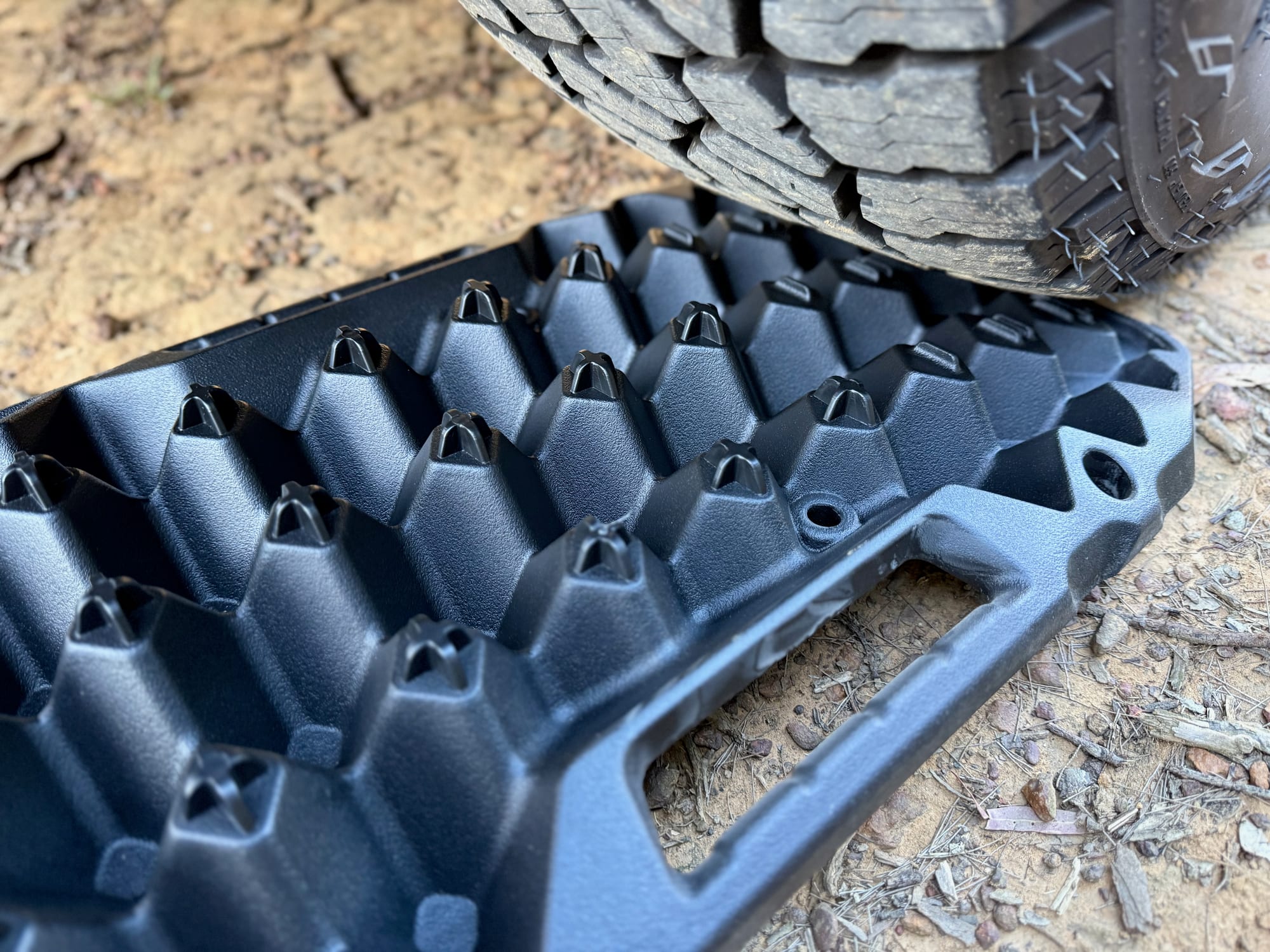
The Bunker Indust tracks are the lightest pair here at 4.6 kg, in UV-stabilised polypropylene with cross-shaped teeth on both sides, shovel ends and a compact 95 mm stack. They got us out of soft sand on Stockton Beach with solid grip and no damage to the boards.
They’re not the sturdiest boards we’ve tested and they’re short like the X-Bull, but for about $95 a pair they’re good enough for most touring.
Bunker Indust Recovery Tracks
Scored 8.9 out of 10Our take: Good enough for the price, and they stack compactly. Read review
We may earn a commission if you buy through these links.What we like
- Teeth on both sides
- Light: 4.6 kg a pair
- Compact 95 mm stack
- Ramp ends double as shovels
- Leashes and mounting holes
- Limited lifetime warranty
What we don’t
- Shorter than premium boards
- Deep pockets hold mud
- Not the sturdiest we’ve tested
Best budget: X-Bull Gen 2.0
The X-Bull Gen 2.0 tracks are reinforced nylon, light for a pair, and have shovel ends and carry handles.
They’re shorter than the Gen 3.0, tall when stacked four high and fiddly to clean after mud. For reliable self-recovery on a budget, they get the job done.
X-Bull Gen 2.0
Scored 8.8 out of 10Our take: Light budget boards that do the job for $75 a pair. The cross-shaped lugs grip in soft sand, both ends work as shovels and a pair weighs 4.7 kg with leashes included. Read review
We may earn a commission if you buy through these links.What we like
- Light: 4.7 kg a pair
- Lugs grip in soft sand
- Shovel ends on both sides
- Rated for 10,000 kg
- Leashes included
- Only $75 a pair
What we don’t
- Shorter than premium boards
- Taller stack (108 mm)
- Fiddly to clean after mud
Slimmest stack: XTM Recovery BoardsSlimmest stack: XTM
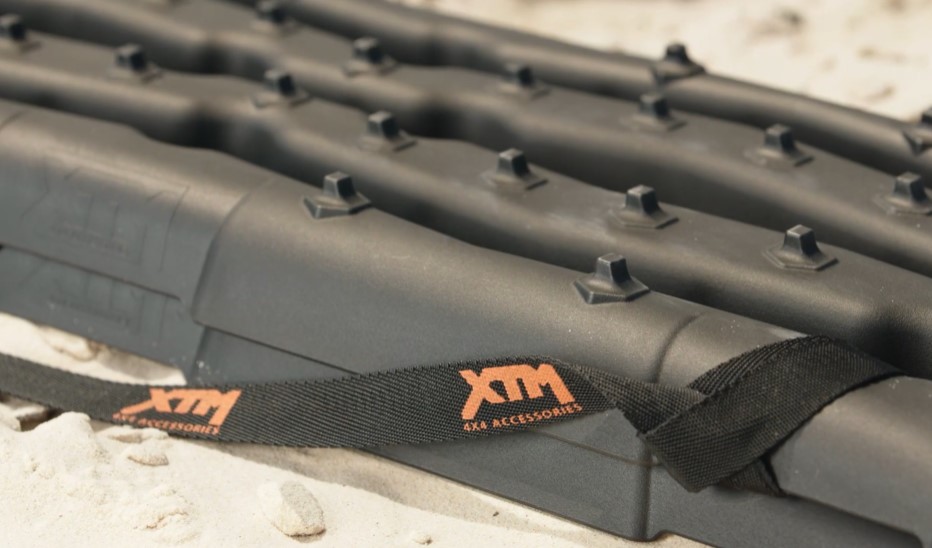
The XTM boards stack slimmer than any other pair here, have a built-in shovel end and several mounting points for roof racks. The teeth grip tyres well in sand and mud.
The black gets extremely hot in the sun and the ramp angle isn’t the most aggressive. They’re a solid choice if storage space is tight.
XTM Recovery Boards
Scored 8.4 out of 10Our take: Dependable boards that gripped well for us in sand and mud. The shovel end helps you dig, there are plenty of mounting holes and leashes, and a pair stacks to just 78 mm. Read review
We may earn a commission if you buy through these links.What we like
- Teeth grip in sand and mud
- Shovel end for digging
- Slim 78 mm stack
- Plenty of mounting holes
- Leashes included
- $200 a pair
What we don’t
- Black gets very hot in the sun
- Ramp isn’t the steepest
- Heavy when caked in mud
How to use recovery tracks
Recovery tracks are simple, but a few habits make them work better and last longer:
Five habits for a quick recovery
- Dig firstClear a path in front of the tyres before you put the boards down; they need a clean ramp to climb.
- Use a pairPut a board under both driving wheels for even grip, not just the one that’s spinning.
- Go gentlyEase on in a low gear; wheel spin melts the teeth and throws boards out behind you.
- Store them securelyMount them on the rack or strap them down: loose boards in the car become projectiles.
- Clean and practiseHose off clay after use, and try them once at home so you know how they feel before you’re stuck.
How to choose recovery tracksHow to choose
Start with where you’ll use them and where they’ll travel. In soft beach sand and deep mud, longer tracks give the tyres more to climb onto; in a small 4WD or on a crowded roof rack, shorter and lighter tracks are easier to carry and mount.
Then look at how they’re built: the teeth, the material and the handles decide how well they grip and how long they last. Recovery tracks come in three lengths:
- Compact
<950 mm
The lightest to carry and easiest to fit inside the car or on a small rack.
Pair weightUnder 5 kgBest forLighter 4WDs and occasional useLike - Mid-length
950–1,100 mm
A good balance of grip and size for most touring setups.
Pair weightAround 5.5–6.5 kgBest forMost beach and track trips - Full-length
1,100+ mm
The most to climb onto in soft sand and deep mud, for heavier vehicles.
Pair weightAround 7 kgBest forHeavy 4WDs and soft sandLike
Also check
- TeethTall, sharp teeth bite into the tread. Check they’re part of the board, not glued on.
- MaterialReinforced, UV-stabilised nylon flexes without cracking and survives years in the sun.
- Stacked heightA slim stack is easier to mount on a rack or a rear door, and leaves room for other gear.
- Leashes and colourLeashes and a bright colour help you find tracks that have sunk into sand or mud.
How we test
We buy the gear ourselves and take it on camping trips around Australia to put it to the test in real outdoor conditions, in the 4WD and at camp, and to see how it holds up over a few trips. We weigh everything on our own scale and photograph it ourselves. If we haven’t used something, we say so, and if anything fails later on, we update the review.
Scored out of 10 on
- Ease of use
- Performance
- Portability
- Durability
- Value