
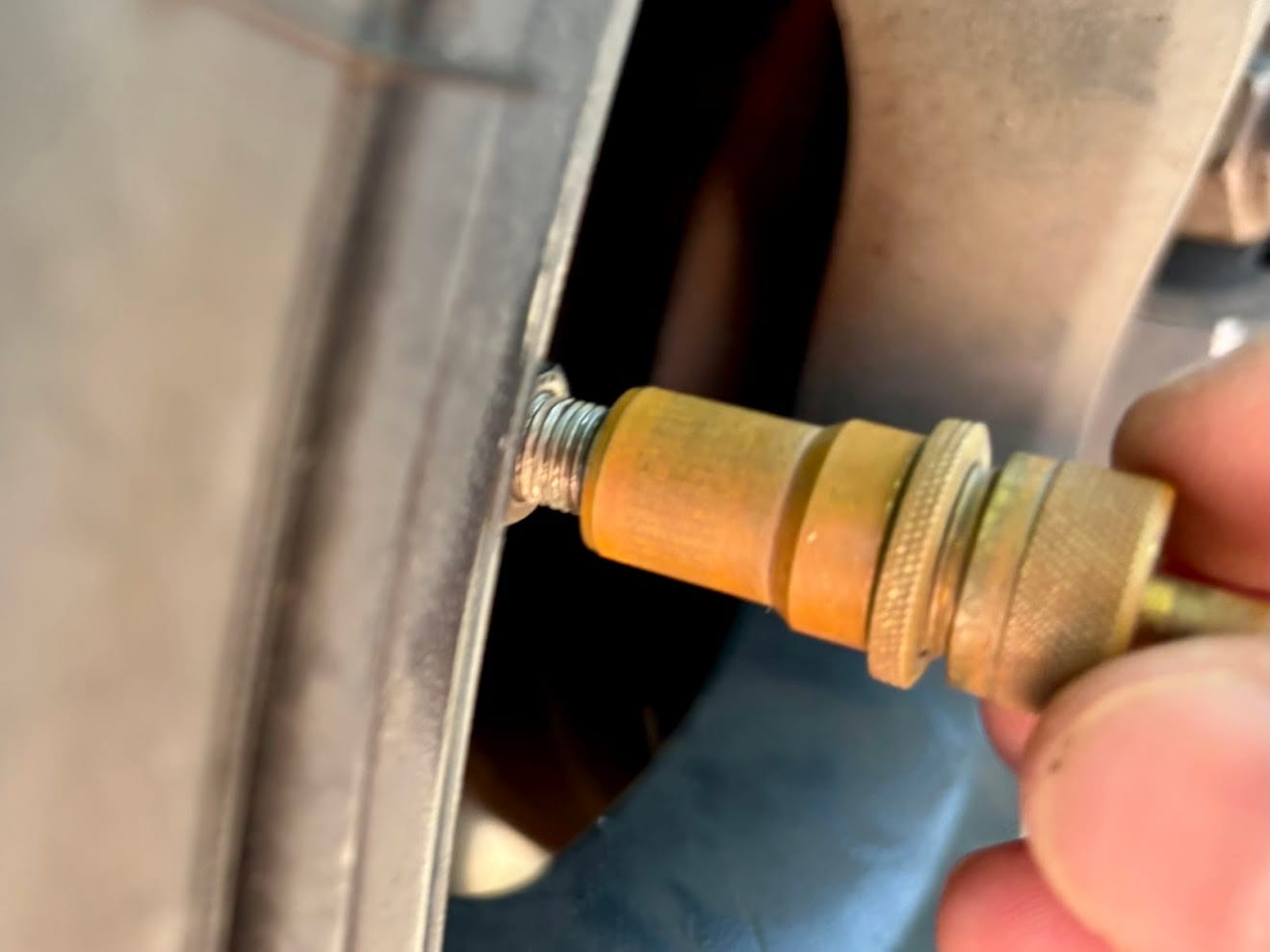
Airing down is the first job when you leave the bitumen. Lower pressure puts more tyre on the ground, which gives more grip on sand and a smoother ride over corrugations. Doing it with a stick or a key is slow, and the four tyres rarely end up at the same pressure.
A tyre deflator fixes that. We’ve reviewed four: three automatic sets and one deflator gauge. We’ve also tested three tyre pressure gauges, which are in the table below as well. Here’s how they compare and which one suits what you do.
Quick picks: the best tyre deflators compared
| Product | Score | Type | Range (PSI) | Weight | Check price |
|---|---|---|---|---|---|
Best overallCampBoss 4x4 Boss Air Tyre Deflators | 9.5 | Automatic × 4 | 5–30 | 114 g | Check price at Amazon |
Best brass setStaun Tyre Deflators | 9.3 | Automatic × 4 | 6–30 | 146 g | Check price at Anaconda |
Best gaugeAstroAI Digital Tyre Pressure Gauge | 9.2 | Digital gauge | 0–150 | 72 g | Check price at Amazon |
Best built gaugeAstroAI Mechanical Tyre Pressure Gauge | 8.9 | Dial gauge | 0–60 | 243 g | Check price at Amazon |
Budget gaugeDune 4WD Tyre Pressure Gauge | 8.8 | Dial gauge | 0–60 | 215 g | Check price at Anaconda |
Best with a gaugeXTM Tyre Deflator Gauge | 8.6 | Manual deflator | 0–70 | 275 g | Check price at BCF |
Budget automaticRapid Tire Deflator Kit | 7.4 | Automatic × 4 | 10–30 | 160 g | Check price at Amazon |




Best overall: CampBoss 4x4 Boss Air Tyre Deflators
The CampBoss Boss Air set scored 9.5, the highest of the four. It’s a set of four automatic deflators that adjust from 5 to 30 PSI. Setting them is the best part: you unscrew the cap, line the body up with the pressure on the laser-etched stem and screw the cap back on. The locking ring holds that setting from trip to trip.
In use they were the fastest way we’ve aired down, about half the time of a valve-core deflator. Set to 15 PSI for deep sand, they stopped on that reading every time. The body is nickel plated against corrosion, the internals are stainless steel, and the whole kit weighs 114 g in a neoprene pouch with a carabiner. They cost $90.
They need a careful first setting, the etched scale has to be kept clean, and 30 PSI is the top of the range. If you air down often, this is the set to get. Read the full CampBoss Boss Air Tyre Deflators review.
The good
- Fastest air down method
- Auto stop at preset PSI (5 to 30)
- Laser etched gauge for setting
- Nickel plated, anti-corrosive body
- 114 gram kit weight
The not-so-good
- Requires initial precise setting
- Gauge must be kept clean
- No option for high PSI road use
Bottom line: Fast, accurate automatic deflators with a laser-etched scale for setting the pressure, a nickel-plated body and a neoprene pouch. They need a precise first setting, and the gauge must be kept clean.
Best brass set: Staun Tyre Deflators
The Staun deflators scored 9.3. They’re four automatic deflators made entirely of brass, adjustable from 6 to 30 PSI and preset to 18 PSI from the factory. The set weighs 146 g in its leather pouch. Screw all four on and they deflate hands-free, and all four tyres end up at the same pressure.
The first setting is fiddly: you deflate a tyre to your target with a separate gauge, then adjust the deflator and lock it. Below 12 PSI you lift the pin by hand to start it, and quick changes of pressure on the track aren’t easy. They cost $80. Once set, they’re a buy-once tool, and they unscrew fully for cleaning out sand. Read the full Staun Tyre Deflators review, or see how to set Staun tyre deflators.
The good
- Made from durable 100% brass
- Adjustable from 6 to 30 PSI range
- Only 146 g including the pouch
- Accurate, hands-free deflation
- Includes a solid leather carry pouch
The not-so-good
- Pre-setting them is fiddly
- Manual pin lift below 12 PSI
- Hard to make quick PSI adjustments
Bottom line: Solid brass deflators that air down all four tyres at once, hands-free and accurately, in a 146 g set with a leather pouch. The first setting is fiddly, and quick pressure changes are hard to make.
Best with a gauge: XTM Tyre Deflator Gauge
The XTM is a different kind of tool: a manual deflator with a built-in dial. It screws onto the valve and removes the valve core, which lets the air out much faster than pressing the pin, and you watch the needle drop to the pressure you want. The dial reads 0 to 70 PSI in 1 PSI steps and has a rubber guard, the fittings are brass and the hose is braided. It weighs 275 g and comes in a zip pouch. It cost $30 and scored 8.6.
It does one tyre at a time, so it isn’t as fast as an automatic set, and there’s no light for airing down in the dark. Grit can get into the connector, so brush it off first. If you change pressures a lot from trip to trip, or want one tool that deflates and measures, this is the one. Read the full XTM Tyre Deflator Gauge review.
The good
- Brass parts and a reinforced hose
- Accurate analogue dial
- Quick deflation
- Compact & portable
- Affordable without feeling cheap
The not-so-good
- Not as fast as automatic deflators
- No light for night use
- Single tyre operation only
Bottom line: A rugged, affordable deflator gauge with brass parts and an accurate analogue dial that removes the valve core for quick deflation. It does one tyre at a time and isn’t as fast as automatic deflators.
Budget automatic: Rapid Tire Deflator Kit
This unbranded four-piece kit cost $29 and scored 7.4. The deflators are stainless steel, adjust from 10 to 30 PSI and stop by themselves at the preset pressure. The kit weighs 160 g. You twist the housing to the pressure you want, lock it, screw them on and walk away.
Accuracy is quoted at plus or minus 2 PSI. They landed close enough for sand and gravel, but they take practice to calibrate and aren’t made for fine-tuning, and the case is basic. As a cheap way to try automatic deflators, they do the job. Read the full Rapid Tire Deflator Kit review.
The good
- Adjustable 10–30 PSI range
- Auto-stop at preset pressure
- Four-piece kit included
- Small and lightweight (160 g)
- +/-2 PSI accuracy
The not-so-good
- Not for fine-tuned PSI
- Takes practice to calibrate
- Case quality is basic
Bottom line: A light four-piece set of automatic deflators that stop at your preset pressure, so you can clip them on and walk away. They take practice to calibrate, aren’t for fine-tuning and the case is basic.
Tyre pressure gauges: check and fine-tune
A gauge isn’t a deflator, so these three aren’t ranked above. But a gauge belongs in the same bag: it tells you where the tyres are before you air down, checks what the deflators left you with, and lets a few PSI out when that’s all you need. We’ve used all three on trips north of Sydney, to the Hunter Valley and up to Seal Rocks for beach driving.
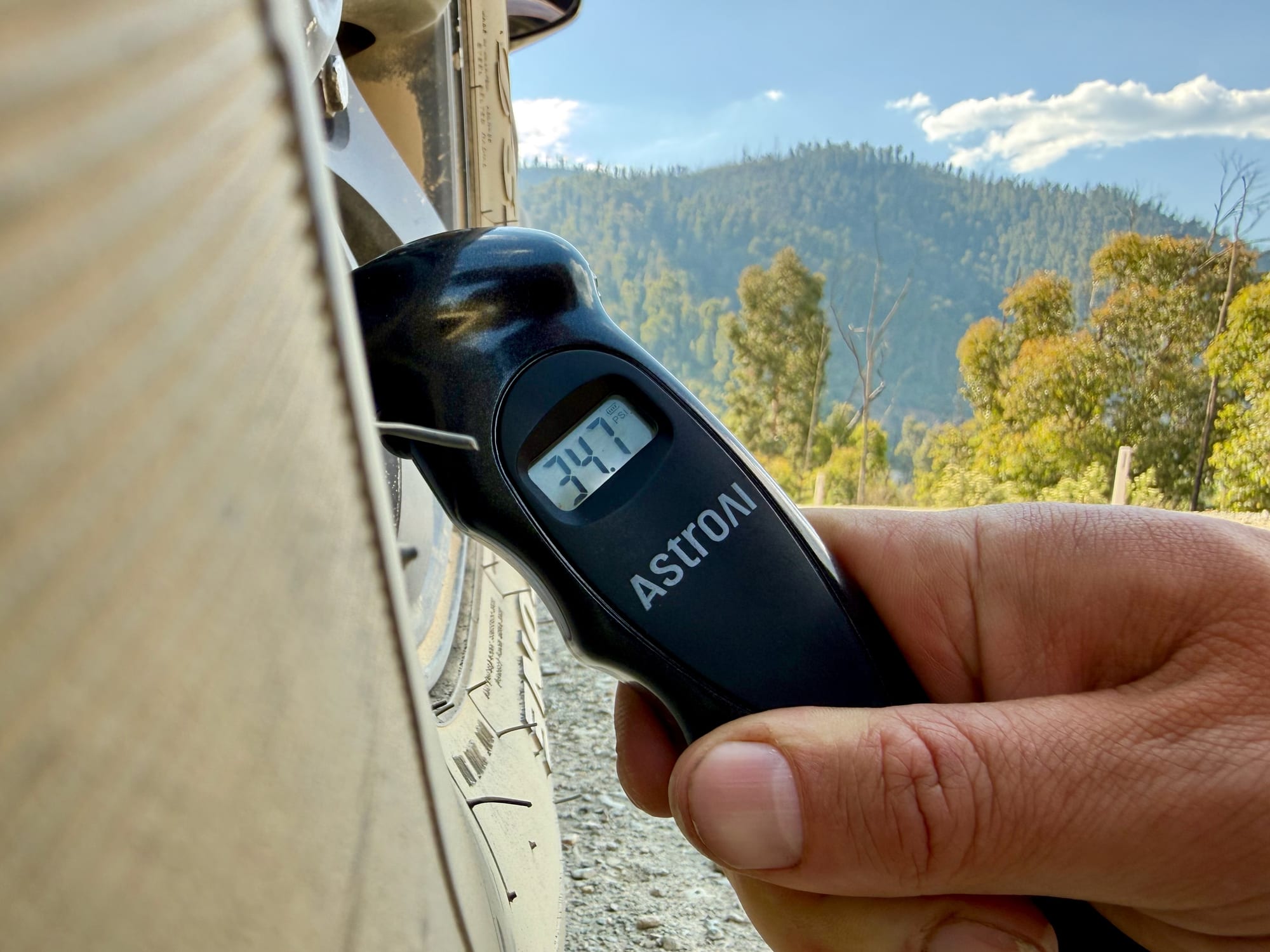
AstroAI Digital Tyre Pressure Gauge (9.2). An awesome little thing that lives permanently in our glovebox. Its readings are very accurate, it shows 0.1 PSI on a backlit display and it weighs 72 g. It also lets air out for a quick deflate on a gravel road. It cost $30. Read the full AstroAI Digital Tyre Pressure Gauge review.
The good
- Very accurate readings
- Easy-to-read backlit display
- Small enough to live in the glovebox
- Also lets air out to deflate
- Runs on two AAA batteries
- Four units: PSI, bar, kPa and kg/cm²
The not-so-good
- Slow for airing down four tyres
- Plastic body
- Switches off after 30 to 40 seconds
Bottom line: A small, accurate digital tyre gauge with an easy-to-read backlit display that runs on two AAA batteries. It also lets air out for a quick deflate. It lives in our glovebox. For airing down all four tyres, use proper deflators.
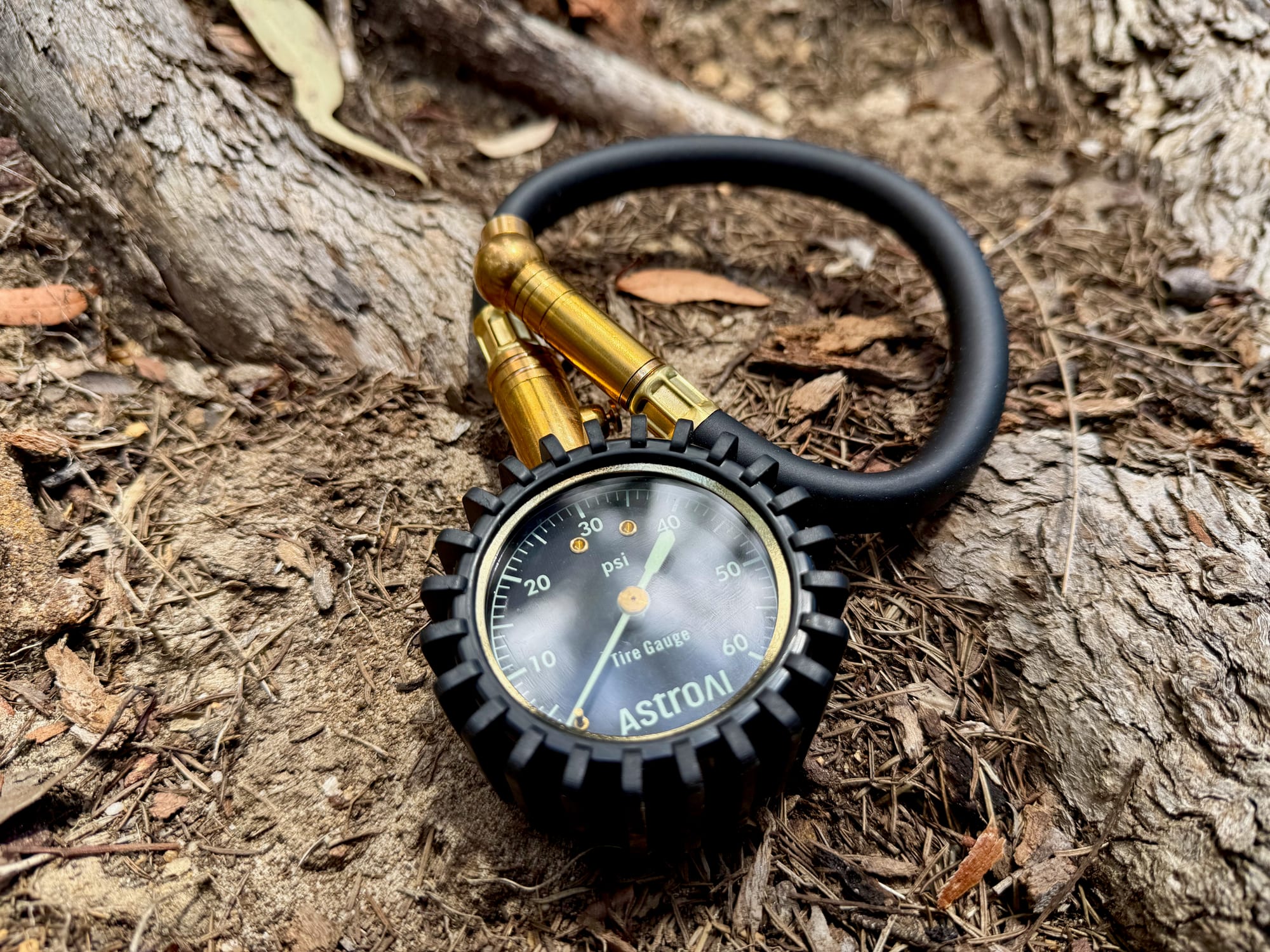
AstroAI Mechanical Tyre Pressure Gauge (8.9). The solid one: brass and steel fittings, a glow-in-the-dark dial, a chuck that swivels all the way round and a bleed valve. It needs no batteries and holds its reading. At 243 g it’s heavy for a gauge. It cost $25. Read the full AstroAI Mechanical Tyre Pressure Gauge review.
AstroAI Mechanical Tyre Pressure Gauge
We may earn a commission if you buy through these links.The good
- Brass and steel build
- Glow-in-the-dark dial
- Chuck swivels 360 degrees
- Bleed valve lets air out
- Holds the reading, no batteries
- Rubber guard around the dial
The not-so-good
- Heavy for a gauge at 243 g
- Too bulky for a glovebox tray
Bottom line: A mechanical gauge with a glow dial, brass and steel fittings, a 360 degree swivel chuck and a bleed valve. No batteries. Heavy at 243 g. $25.
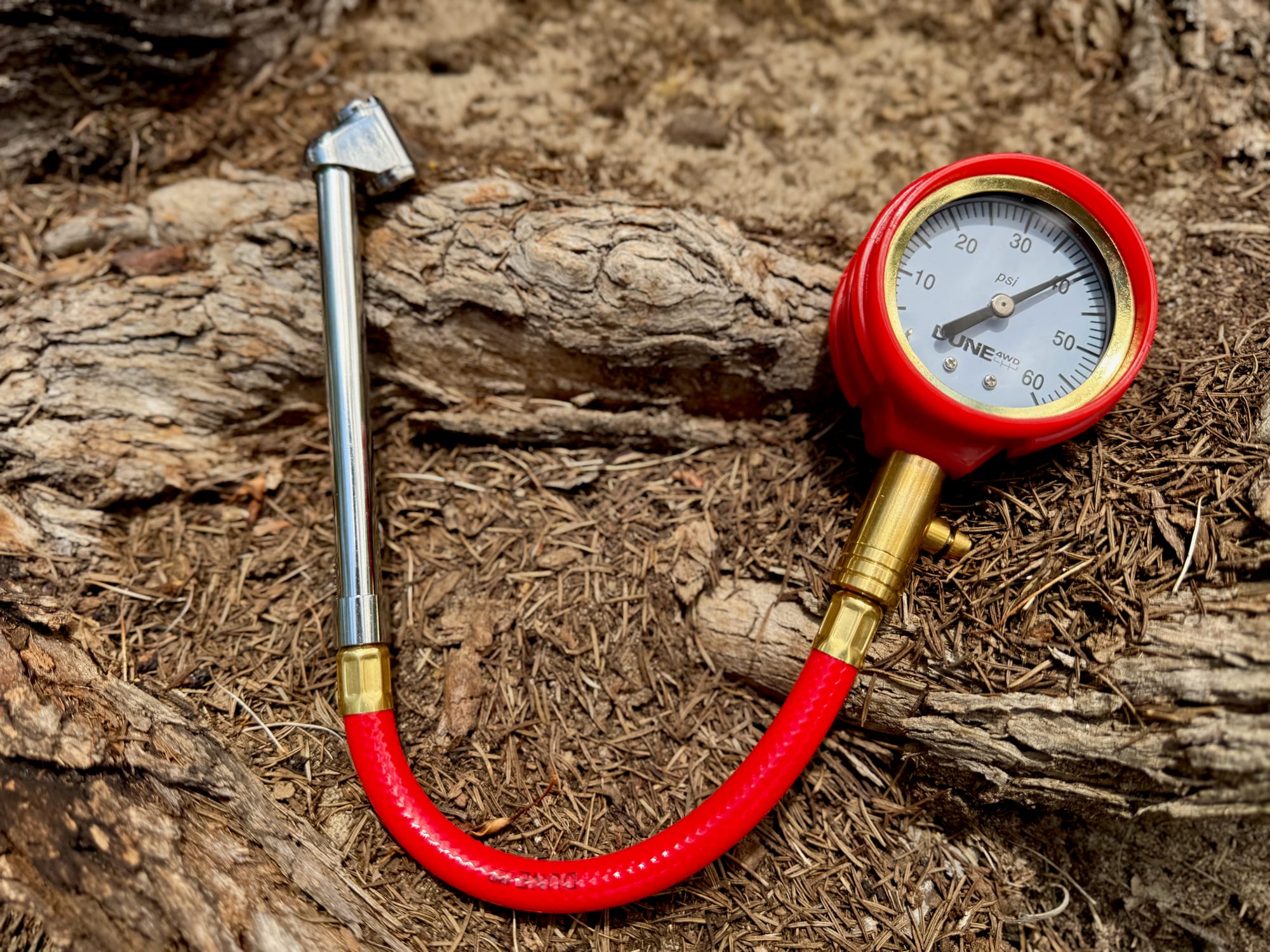
Dune 4WD Tyre Pressure Gauge (8.8). A simple analog gauge with a big, clear 0 to 60 PSI dial, a flexible hose and a release valve for letting air out. No batteries, and the cheapest of the three at $20. Read the full Dune 4WD Tyre Pressure Gauge review.
The good
- Big, clear analog dial
- No batteries needed
- Holds the reading until you release
- Release valve lets air out
- Flexible hose reaches the valve
- Rubber surround protects the dial
The not-so-good
- Tops out at 60 PSI
- Bulkier than a digital gauge
- A drop can affect its accuracy
Bottom line: An analog 0 to 60 PSI gauge with a big dial, a flexible hose and a release valve for letting air out. No batteries. 215 g, and it doesn’t like being dropped. $20.
How to choose a tyre deflator
- Automatic or manual
An automatic set does all four tyres at once and stops by itself. A deflator gauge does one tyre at a time, but you can stop at any pressure without resetting anything.
- Pressure range
Check the lowest setting if you drive soft sand. The CampBoss goes down to 5 PSI and the Staun to 6 PSI. The budget kit stops at 10 PSI.
- How you set them
A marked scale, like the CampBoss has, is the quickest. The Staun needs a separate gauge for the first setting. After that, both hold their setting.
- Accuracy
Premium sets stop at the same pressure on every tyre. With a budget kit, check the result with a gauge.
- Materials
Brass, nickel plating and stainless steel all resist rust. Whatever they’re made of, rinse out sand and mud after a beach trip.
- Price
The two premium sets cost $80 to $90. The gauge and the budget kit cost about $30.
Not sure what pressure to run? See our guide on how to determine PSI for your 4WD tyres. And for getting the air back in afterwards, see the best tyre inflators and air compressors.
How we test
We buy the gear ourselves and take it on camping trips around Australia to put it to the test in real outdoor conditions, in the 4WD and at camp, and to see how it holds up over a few trips. We weigh everything on our own scale, photograph it ourselves, and score it on five things: ease of use, performance, portability, durability and value. If we haven’t used something, we say so, and if anything fails later on, we update the review.
